
Table of Contents
- Is Pediatric Chiropractic Care Safe? What Parents Should Know
- Chiropractic Care for Babies and Children: How Treatment Is Adapted
- The Nervoscope Chiropractic Examination: A Tool for Precision
- Risks of Chiropractic Adjustments for Children: What the Evidence Shows
- What to Ask a Pediatric Chiropractor Before Consent
- Red Flags: When a Child Needs Medical Evaluation Instead
- Pros and Cons of Pediatric Chiropractic Care
- Frequently Asked Questions
Last Updated: October 21, 2026
Is Pediatric Chiropractic Care Safe? What Parents Should Know
Pediatric chiropractic care is a type of manual therapy that uses gentle, controlled contact to address movement and alignment concerns in babies and children. Parents ask whether it is safe because the answer depends on the child, the technique, and the training of the provider. At Kaminski Chiropractic, we tell every family the same thing: safety starts with a careful exam, not with an adjustment.
The honest answer is that pediatric chiropractic care is generally considered low-risk when a trained practitioner adapts treatment to a child’s size and stage of development. Below, we explain how treatment differs for children, what the research does and does not show, and the exact questions to ask before you consent.
Chiropractic Care for Babies and Children: How Treatment Is Adapted
Treatment for babies and children is adapted through lighter pressure, shorter sessions, and a narrower scope than adult care. A pediatric chiropractor uses gentle techniques that match a child’s developing body rather than the firm thrusts used on adults.
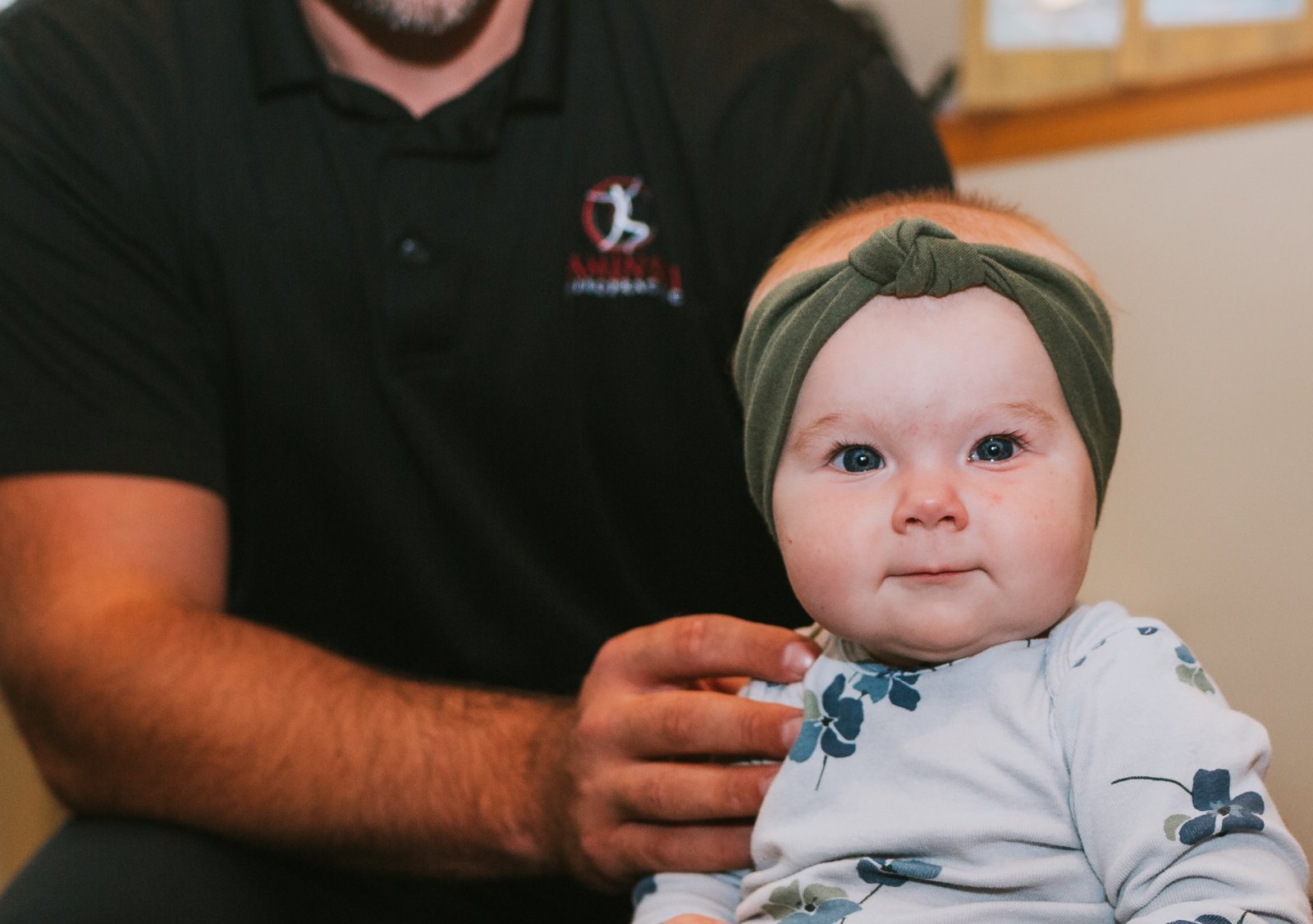
Pediatric evaluations are gentle and safe for children of all ages – including newborns.
A common mistake is assuming a child receives a scaled-down adult adjustment. In practice, the approach changes more than the force does. Infants are often assessed and treated while held by a parent. Toddlers may be examined while sitting or playing. Older children can cooperate with standard positioning.
The treatment plan usually follows a few principles:
- Individual assessment before any contact
- Gentle techniques with light fingertip pressure
- Age-appropriate positioning for comfort and safety
- Shorter visits than an adult would receive
- Parental consent and family involvement at every step
Ten Ways Pediatric Chiropractic Care Supports Your Child’s Health and Development: https://www.palmer.edu/palmer-blog/10-ways-pediatric-chiropractic-care-supports-your-childs-health-and-development/
Age-Specific Safety Guidance for Newborns, Infants, and Toddlers
Safety guidance changes with age. Newborns and infants deserve the most caution because their spines and joints are still forming. Many practitioners prefer to evaluate an infant only after a pediatrician has ruled out medical causes for symptoms.
For toddlers, the main risk is restlessness during treatment. A trained practitioner keeps contact light and brief, and stops if the child resists. Older children can usually describe what they feel, which makes feedback easier and safer.
The Nervoscope Chiropractic Examination: A Tool for Precision
The nervoscope is a hand-held instrument that glides along the spine to detect small differences in skin temperature, which practitioners use as one signal of nerve pressure and spinal imbalance. It is a screening tool, not a diagnosis on its own.
At Kaminski Chiropractic, the nervoscope is part of a five-component Gonstead analysis. This matters for families because the Gonstead technique is built on specificity: the goal is to find the exact segment under stress rather than adjust the whole spine. For a child, that precision is the point. Less guesswork means less unnecessary contact.
A nervoscope reading is combined with other findings, never used alone. That is the difference between a careful exam and a quick crack.
Risks of Chiropractic Adjustments for Children: What the Evidence Shows
The risks of chiropractic adjustments for children are generally described as mild and short-lived, but the research evidence is limited and parents should weigh that honestly. Common mild side effects include temporary soreness, fussiness, or tiredness after a visit, usually resolving within a day or two.
Here is where most guides get it wrong. They either call pediatric care completely safe or completely unsafe. Neither claim holds up. The clinical evidence is thin, which means the responsible position is cautious, not confident. A 2017 review published in the journal Chiropractic & Manual Therapies and a 2018 commentary in Pediatrics both noted that pediatric spinal manipulation lacks the large, well-controlled studies needed to establish safety rates. That is not proof of harm. It is proof of uncertainty, and parents deserve to hear it stated plainly.
Chiropractic Care in Children: A Review of Evidence and Safety: https://pmc.ncbi.nlm.nih.gov/articles/PMC12138143/
Adverse Events, Severity, and Reporting Limitations
Serious adverse events in children appear to be rare, but the true rate is unknown because reporting is voluntary and inconsistent. That gap is a reporting limitation, not proof of safety. Many mild reactions are never recorded at all.
What the numbers actually measure matters. Case reports and retrospective surveys capture events that someone chose to write down. They do not capture every visit, every child, or every mild reaction. When a review says serious events are ‘rare,’ it usually means rare among reported cases, not rare across all pediatric visits. The denominator is missing.
Severity is also classified loosely. A mild event might be soreness or crying that settles without treatment. A moderate event might involve temporary worsening of symptoms or a visit to a pediatrician. A serious event means hospitalization, permanent injury, or death.
What parents should take from this:
- Mild side effects are the most commonly described reactions
- Serious harm is reported rarely but is not well tracked
- Absence of data is not the same as absence of risk
- A provider who explains this uncertainty is being honest, not evasive
- Ask whether the practice tracks and reviews its own adverse events (Source: the Gonstead System’s principles)
How the Gonstead Technique and Nervoscope Fit Into a Safer Visit
The Gonstead technique is built on specificity: the goal is to find the exact segment under stress rather than adjust the whole spine. The nervoscope, a hand-held instrument that glides along the spine, detects small differences in skin temperature that practitioners use as one signal of nerve pressure and spinal imbalance. It is a screening tool, not a diagnosis on its own.
At Kaminski Chiropractic, the nervoscope is part of a five-component Gonstead analysis that also includes full-spine X-rays and thermal scanning. For a child, that precision is the point. Less guesswork means less unnecessary contact, and a narrower treatment target means fewer segments are touched. A nervoscope reading is combined with other findings, never used alone. That is the difference between a careful exam and a quick crack.
What to Ask a Pediatric Chiropractor Before Consent
Before you consent, ask direct questions about training, technique, and what happens if treatment is not appropriate. A qualified provider welcomes them. The gap most guides leave is what a good answer actually sounds like, so use the checklist below and compare the response against the notes in the right-hand column.
Use this checklist:
- What specialized training do you have in pediatric care?
- Are you a licensed chiropractor in good standing?
- How will you adapt treatment for my child’s age?
- What is your treatment approach if symptoms do not improve?
- Will you coordinate with our pediatrician?
- What are the specific risks for my child?
- How will you obtain and document parental consent?
- What red flags would make you stop and refer us out?
|
Question |
What a Strong Answer Sounds Like |
Why It Matters |
|---|---|---|
|
Pediatric training |
Names specific coursework, continuing education, or mentorship in pediatric care |
Training in pediatric expertise varies between practitioners |
|
Licensure |
Offers a license number you can verify with the state board |
Confirms standing and scope of practice |
|
Age adaptation |
Describes lighter pressure, shorter visits, and parent-held positioning for infants |
Matches technique to a child’s developmental stage |
|
Plan if no improvement |
Sets a review point and a referral pathway |
Prevents open-ended treatment without progress |
|
Coordination |
Agrees to share findings with the pediatrician |
Supports collaborative care rather than replacing it |
|
Specific risks |
Explains mild reactions and the limits of the evidence |
Builds informed consent on honest ground |
|
Consent |
Describes written consent and how it is documented |
Protects the child and the parent |
|
Red flags |
Lists symptoms that trigger a stop and referral |
Shows the provider puts medical evaluation first |
A real conversation about risk assessment and informed decision-making is a good sign. So is a provider who asks for your child’s medical history and welcomes communication between providers. Watch for the opposite: vague answers about training, a promise to fix a condition rather than a plan to assess it, or reluctance to coordinate with your pediatrician. Any of those is a reason to slow down.
Best Practices For Chiropractic Care in Children: https://www.acatoday.org/news-publications/research-review-best-practices-for-chiropractic-care-of-children/
Red Flags: When a Child Needs Medical Evaluation Instead
Some symptoms call for medical evaluation before any manual therapy. These are the situations where manipulation should wait.
Seek a pediatrician or emergency care for:
- Fever with neck stiffness
- Sudden weakness, numbness, or trouble walking
- Severe headache or vomiting
- A recent fall or injury
- Unexplained weight loss or night pain
- Any symptom that is getting worse
These are contraindications to chiropractic treatment until a physician clears them. A responsible practitioner will refer you out rather than proceed.
Pros and Cons of Pediatric Chiropractic Care
The pros and cons come down to gentle, individualized care against limited evidence and uneven practitioner training. Here is the balanced view.
Pros:
- Gentle, non-invasive approach with age-appropriate treatment
- Careful individual assessment and a tailored treatment plan
- Focus on function and comfort rather than medication
- Providers often work alongside pediatricians in collaborative care
Cons:
- Research evidence is limited
- Training in pediatric expertise varies between practitioners
- Serious adverse events are poorly tracked
- Results depend heavily on choosing the right provider
|
Question |
What to Look For |
Why It Matters |
|---|---|---|
|
Training |
Pediatric-specific coursework and licensure |
Matches skill to a child’s needs |
|
Technique |
Gentle, light-pressure methods |
Reduces strain on a growing spine |
|
Exam |
Full history and medical clearance |
Rules out contraindications |
|
Communication |
Willingness to coordinate with a pediatrician |
Supports collaborative care |
|
Transparency |
Honest talk about limited evidence |
Builds informed consent |
Our view is simple. Pediatric chiropractic care can be a reasonable part of a child’s health plan when a well-trained practitioner does a thorough exam first. It is not a substitute for medical care, and any provider who promises otherwise is a reason to walk away.
Every parent deserves clear answers before a child receives any kind of care. If you are weighing pediatric chiropractic care for your family, the team at Kaminski Chiropractic starts with a full history and a precise Gonstead evaluation, including nervoscope scanning, so you know exactly what we found before anything is adjusted.
Frequently Asked Questions
Is pediatric chiropractic care safe for babies and children?
Pediatric chiropractic care is generally considered low-risk when performed by a licensed chiropractor with specialized training in treating children. Techniques are modified to use very light pressure, often no more than a fingertip, and avoid the forceful rotations. However, research evidence on safety for children is limited. Parents should discuss any underlying conditions with the chiropractor and their pediatrician before consenting, and choose a practitioner who explains each step and welcomes questions.
What are the risks of chiropractic adjustments for children?
Reported risks of chiropractic adjustments for children include mild side effects such as temporary soreness, fussiness, or fatigue. Serious adverse events are rare, but the evidence base is limited and reporting systems may undercapture them. Children with certain medical conditions, such as spinal cord abnormalities or severe infections, should not receive an adjustment. A thorough health history and open communication between the chiropractor and the child’s pediatrician help reduce risk.
What should parents ask a pediatric chiropractor before a child’s first visit?
Before consenting, ask about the chiropractor’s training and experience with children, the specific techniques they plan to use, and how they modify pressure for a child’s developing body. Request a clear explanation of the proposed treatment plan, including frequency and expected duration. Ask how they screen for contraindications, whether they will coordinate with your pediatrician, and what signs would prompt them to stop care and refer your child for medical evaluation.
How does a nervoscope chiropractic examination work?
A nervoscope is a handheld instrument that measures temperature differences along the spine, which can indicate areas of nerve pressure or inflammation. During a nervoscope chiropractic examination, the practitioner slowly runs the device down the back to identify asymmetries. The readings are used alongside other assessments, such as a health history and physical exam, to guide precise, targeted adjustments. It is a non-invasive tool and does not involve radiation.