
Last Updated: October 27, 2026
Quick Summary
Do seated and standing stretches at your desk, such as the seated spinal twist, knee-to-chest, and standing back extension, holding each for 30 seconds. Break up sitting every hour and pair stretches with 60 seconds of walking to relieve lower back pain.
- Sitting keeps your spine forward-flexed, which loads discs unevenly and weakens supporting muscles.
- Hold most desk stretches for 30 seconds per side; standing back extension takes 10 to 15 seconds.
- Week 1 starts with one two-minute break per hour using only seated stretches.
- A stretch plus 60 seconds of walking relieves lower back pain better than stretching alone.
- Seek professional care if pain persists, returns, or comes with red-flag symptoms.
Table of Contents
- Why Prolonged Sitting Causes Lower Back Pain
- Lower Back Stretches at Desk: 7 Seated and Standing Options
- How Often to Stretch for Lower Back Pain
- Eye Strain and Neck Pain
- Adapting Stretches for Different Mobility Levels
- When to See a Chiropractor for Lower Back Pain
- Why a Gonstead Chiropractor Is the Right Choice
- Building a Daily Routine That Fits Your Workday
- Request an Appointment at Kaminski Chiropractic
- Frequently Asked Questions
Why Prolonged Sitting Causes Lower Back Pain
Most office workers blame their chair. The chair is only half the problem. (Source: data on sedentary work habits)
Sitting for long stretches keeps your spine locked in a forward-flexed posture. Your hips stay bent, your back rounds, and the muscles that support your lower back go quiet. Over weeks and months, that stillness adds up to stiffness, muscle tension, and the kind of ache that greets you at 3 p.m. every day.
The pain is real. Understanding what sitting does to your body is a place to start.
The Forward-Flexed Posture Problem
Forward-flexed posture is a position where your spine curves forward and your shoulders roll in, usually from hunching over a keyboard. In that position, the discs in your lower back carry uneven load. The muscles in front of your spine shorten. The ones behind it stretch and weaken.
The result can be a back that feels tight, tired, and sore by the end of the workday.
Tight Hips and Muscle Tension
Your hip flexors connect your pelvis to your thigh. Patients regularly report “tight hip flexors” when more commonly it is a weak hip flexor issue. When seated, the muscle is shortened for long periods of time. Once we stand up, that muscle is stretched and contracted at full capacity, fatiguing the muscle quickly and causing a protective mechanism. Stronger hip flexors allow more capacity for work and can endure the longer periods of sitting.
Lower Back Stretches at Desk: 7 Seated and Standing Options
These seven moves cover both seated and standing options, so you can stretch without leaving your workspace. For guided, tailored corrective stretches and exercises, explore corrective stretches and exercises in Grand Rapids.
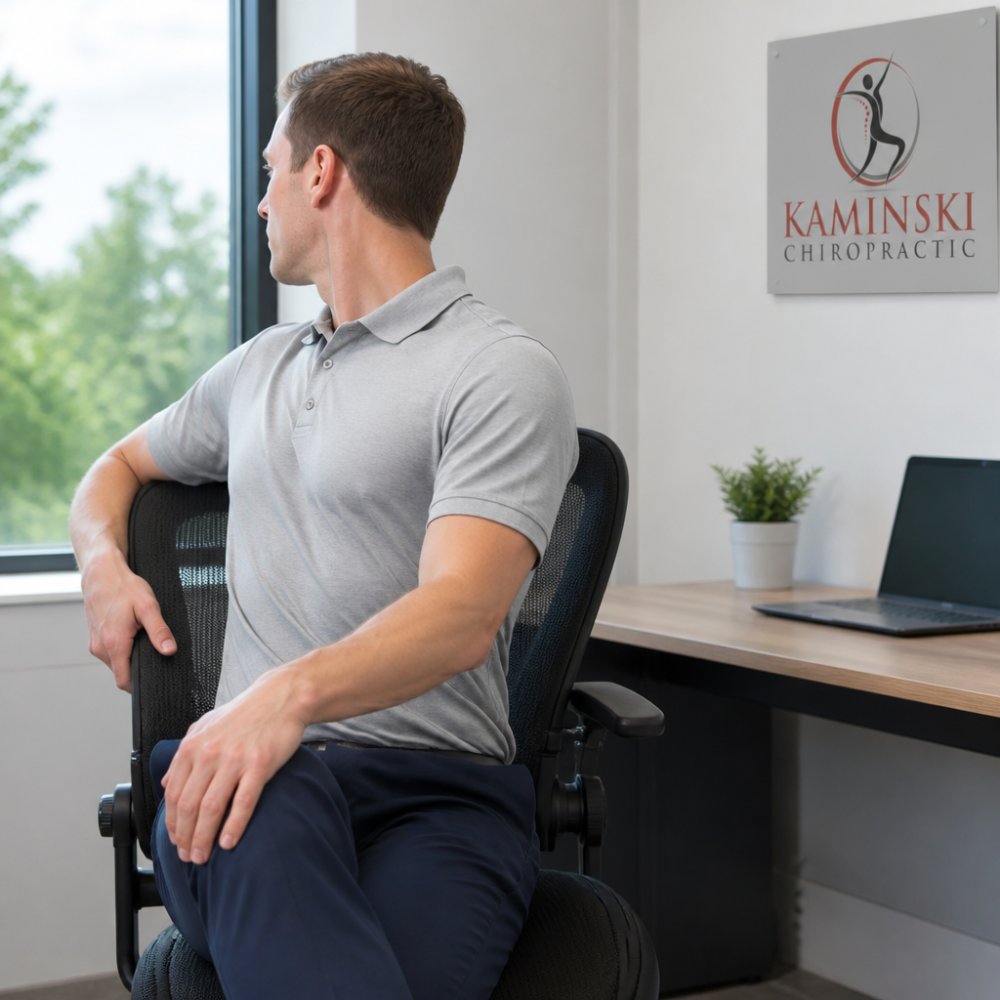
Seated Spinal Twist
Sit tall with both feet flat on the floor. Place your right hand on the back of your chair and your left hand on your right knee. Turn your chest to the right until you feel a gentle stretch through your mid and lower back. The goal here isn’t maximum rotation. Rotate to where your back naturally stops, then lengthen your spine and try to get as vertical as you can. Hold for 30 seconds, then repeat on the other side.
Seated Knee-to-Chest Stretch
Sit near the front of your chair. Lift one knee toward your chest and hug it with both hands. Keep your back straight and lean back slightly until you feel the stretch in your lower back and hip. Hold for 30 seconds, then switch legs.
If hugging your knee is hard on your hip, hold the back of your thigh instead.
Standing Back Extension
Stand with your feet hip-width apart and place your hands on your lower back. Gently press your hips forward and lean back until you feel a stretch across your lower back. Keep the chest upright and avoid cranking your neck. Hold for 10 to 15 seconds and repeat a few times.
Standing Hamstring Stretch
Place one heel on a low stool or the edge of a desk drawer with your leg straight. Keep your back flat and hinge forward from your hips until you feel a stretch behind your thigh. Hold for 30 seconds, then switch sides.
Standing Hip Flexor Stretch
Step one foot back into a half-kneeling or split stance. Tuck your pelvis slightly and press the hips forward until you feel a stretch at the front of your back leg. Keep the chest upright. Hold for 30 seconds, then switch sides.
Standing Upper Back Stretch (Wall Angels)
Stand with your back against the wall. Bring your arms all the way back to the wall with your elbows bent (like a field goal), slowly raise arms straight up, keeping them against the wall the entire time. Retract your shoulder blades will bringing your arms back down and squeeze for a second at the bottom. Repeat 15-20 times
Seated Piriformis Stretch
Sit tall and cross one ankle over the opposite knee. Keep your back straight and lean forward gently until you feel a stretch in the back of your hip. Hold for 30 seconds, then switch sides.
The piriformis is a small muscle deep in the hip.
Here are the seven desk-friendly stretches the article covers, with how long to hold each one.
|
Stretch |
Position |
Hold time |
|---|---|---|
|
Seated spinal twist |
Seated |
30 seconds per side |
|
Seated knee-to-chest |
Seated |
30 seconds per leg |
|
Standing back extension |
Standing |
10 to 15 seconds, repeat a few times |
|
Standing hamstring stretch |
Standing |
30 seconds per side |
|
Standing hip flexor stretch |
Standing |
30 seconds per side |
|
Wall Angels |
Standing at wall |
15-20 reps |
|
Seated piriformis stretch |
Seated |
30 seconds per side |
How Often to Stretch for Lower Back Pain
The goal isn’t a long session at the end of the day; it’s breaking up the accumulated stiffness from prolonged sitting. A practical target is a movement break during the workday, plus a longer routine at the start or end of the workday. (Source: the Gonstead system)
A Sample Weekly Progression
- Week 1: one two-minute break per hour using only seated stretches (spinal twist, knee-to-chest, piriformis).
- Weeks 2-3: add one standing stretch per break (back extension or hip flexor stretch) and hold each for 20 seconds.
- Week 4 and beyond: build to 30-second holds, add the hamstring and wall angels, and include one longer morning or evening routine.
Pair Stretches With Movement Breaks
Stretching is only half of the equation. A movement break that combines a stretch with 60 seconds of walking, standing, or a few bodyweight squats does more for lower back pain relief than stretching alone, because it restores blood flow and interrupts the sustained load on your discs. Try this pattern: stand, walk to fill your water bottle, then run through two seated or standing stretches before you sit back down.
Eye Strain and Neck Pain
Longer periods of time at the computer lead to eye strain that will eventually translate into neck pain. The best recommendation is the 20/20/20 rule. Every 20 minutes, look 20 feet away, for 20 seconds.
Adapting Stretches for Different Mobility Levels
Not every stretch fits every body. A good rule: move into a gentle stretch, never into sharp pain.
Modifications by Mobility Level
- Stiff after years at a desk: start with seated options and hold each stretch for 15 to 20 seconds before building to 30. Use a chair with armrests for support during the seated twist.
- Limited floor mobility or balance concerns: stay with seated and standing moves and skip anything that requires kneeling. Do standing stretches with one hand on a desk or wall for stability.
- Hypermobile or ‘loose’ joints: avoid end-range stretching and focus on controlled movement and strengthening instead; stretching loose tissue can worsen instability.
- Post-surgery or recent injury: get clearance from your clinician before starting any new routine, and avoid spinal extension or twisting until you’re cleared.
When a Stretch Makes Pain Worse
If you’re unsure which movements suit your body, consider consulting a qualified professional.
When to See a Chiropractor for Lower Back Pain
Stretching isn’t a fix for every case. Consider seeking professional care if your pain persists, keeps coming back, or comes with other concerning symptoms.
A qualified professional can assess your symptoms and discuss appropriate next steps. You can also see how our clinic treats back pain in Grand Rapids.
Watch out: if you have sudden severe pain after a fall, loss of bladder or bowel control, or unexplained weight loss alongside back pain, get medical care right away rather than waiting.
Why a Gonstead Chiropractor Is the Right Choice
The Gonstead system is a precise, hands-on approach to chiropractic care.
A five-component Gonstead analysis includes full-spine X-rays and thermal scanning.
If you want to understand how this approach compares, our breakdown of how Gonstead differs from general adjustments walks through it step by step. For a deeper look at the technique itself, read our complete guide to the Gonstead technique for back pain.
Building a Daily Routine That Fits Your Workday
The best stretching routine is the one you’ll actually do. Build it around your calendar, not the other way around.
- Morning: two minutes of standing back extension and hip flexor stretch before your first meeting.
- Mid-morning: a seated spinal twist and calf stretch at your desk.
- Lunch: a short walk, then a hamstring stretch.
- Afternoon: a seated piriformis stretch and knee-to-chest stretch.
- Evening: a few minutes of gentle stretching before bed.
Pair each stretch with a habit you already have, like ending a call or refilling your water. That’s how a routine sticks.
Request an Appointment at Kaminski Chiropractic
If desk work has left you with lower back pain that keeps returning, consider consulting a qualified professional.
At Kaminski Chiropractic, Dr. Paul Kaminski brings over a decade of experience and a Gonstead-focused approach to every patient. Our care includes a five-component analysis with full-spine X-rays and thermal scanning, and precise hands-on adjustments.
You can request an appointment.
Frequently Asked Questions
What stretches help lower back pain from sitting at a desk?
A seated spinal twist, seated knee-to-chest stretch, standing back extension, and standing hip flexor stretch are options to consider. You can also consider a standing hamstring stretch and calf stretch.
How often should office workers stretch their lower backs?
Consider taking movement breaks during desk work and building a stretching routine that fits your schedule.
When should I see a chiropractor for lower back pain?
Consider consulting a qualified professional if your lower back pain persists, keeps returning, or concerns you. Kaminski Chiropractic uses the Gonstead system and a five-component analysis that includes full-spine X-rays and thermal scanning.
What makes a Gonstead chiropractor different?
A five-component Gonstead analysis includes full-spine X-rays and thermal scanning. Dr. Paul Kaminski at Kaminski Chiropractic has over a decade of experience and a perfect 5-star rating on Google
