
Last Updated: November 11, 2026
Quick Summary
Chiropractic treatment for carpal tunnel works by restoring joint motion and easing nerve pressure along the whole median nerve pathway, from the neck and shoulder down to the wrist. Care may include wrist adjustments, mobilization, soft tissue release, traction, and nerve gliding, often paired with home exercises.
- A pinched nerve in the neck or tight shoulder muscles can cause the same tingling and numbness felt in the fingers.
- The carpal tunnel is a narrow passage where the median nerve shares space with nine flexor tendons.
- Traction is typically applied along the long axis of the forearm and held for 10 to 30 seconds at a time.
- Ice the wrist for 10 to 15 minutes after activity to help reduce inflammation between visits.
- Soreness for 24 to 48 hours after a session is normal, but sharp new pain or spreading numbness is not.
Table of Contents
- Why Carpal Tunnel Symptoms Start in the Neck and Shoulder
- How Chiropractic Treatment for Carpal Tunnel Relieves Nerve Pressure
- Chiropractic Wrist Adjustment Techniques Used in Practice
- What to Expect at Your First Visit
- Ergonomic Tips for Carpal Tunnel Prevention at Your Desk
- How to Reduce Wrist Inflammation Naturally
- Recovery After an Adjustment and When to Expect Results
- Requesting a Consultation at Kaminski Chiropractic
- Frequently Asked Questions
Why Carpal Tunnel Symptoms Start in the Neck and Shoulder
Carpal tunnel syndrome is a compression of the median nerve as it passes through the wrist (Carpal Tunnel Syndrome Symptoms & Causes| NIAMS). But the nerve starts far higher. It leaves the spinal cord in the neck, runs through the shoulder, and travels down the arm before it ever reaches your hand. (Source: National Institute of Arthritis and Musculoskeletal and Skin Diseases (NIAMS))
That path matters. A pinched nerve in the neck or tight muscles around the shoulder can create the same tingling, numbness, and weakness people feel in their fingers. This is why chiropractic treatment for carpal tunnel often begins above the wrist, not at it.
At Kaminski Chiropractic in Grand Rapids, MI, we look at the whole nerve pathway. A problem that starts in the neck is often not solved by treating the wrist alone.
Watch for these clues that the neck or shoulder is involved:
- Numbness that changes when you turn your head
- Pain that spreads from the shoulder down the arm
- Weak grip that comes and goes
- Headaches or neck stiffness alongside hand symptoms
If neck or shoulder pain is part of your picture, our team can walk you through how we treat neck pain and shoulder pain in Grand Rapids.
How Chiropractic Treatment for Carpal Tunnel Relieves Nerve Pressure
Chiropractic treatment for carpal tunnel is generally aimed at restoring joint motion and easing nerve pressure. When joints in the neck, shoulder, or wrist stop moving well, nearby tissues may tighten and nerve pressure can build.
Research on manual therapy for carpal tunnel syndrome is still developing, so results vary from person to person.
Here is what care typically aims to do:
- Remove pressure from the nerve root
- Free up restricted joints in the neck and wrist
- Reduce muscle tension that squeezes the nerve
- Improve blood flow to irritated tissues
- Restore normal wrist and hand motion
We may pair adjustments with soft tissue work, cold laser therapy home exercises. The goal is less pressure on the nerve and better function.
For patients whose wrist symptoms are the main concern, our carpal tunnel care in Grand Rapids page explains the full approach.
Chiropractic Wrist Adjustment Techniques Used in Practice
The carpal tunnel is a narrow passage formed by the carpal bones and the transverse carpal ligament, and the median nerve shares that space with nine flexor tendons (Carpal tunnel: Normal anatomy, anatomical variants and ultrasound technique). Any technique that changes joint motion or soft tissue tension in that passage has to respect how little room the nerve has.
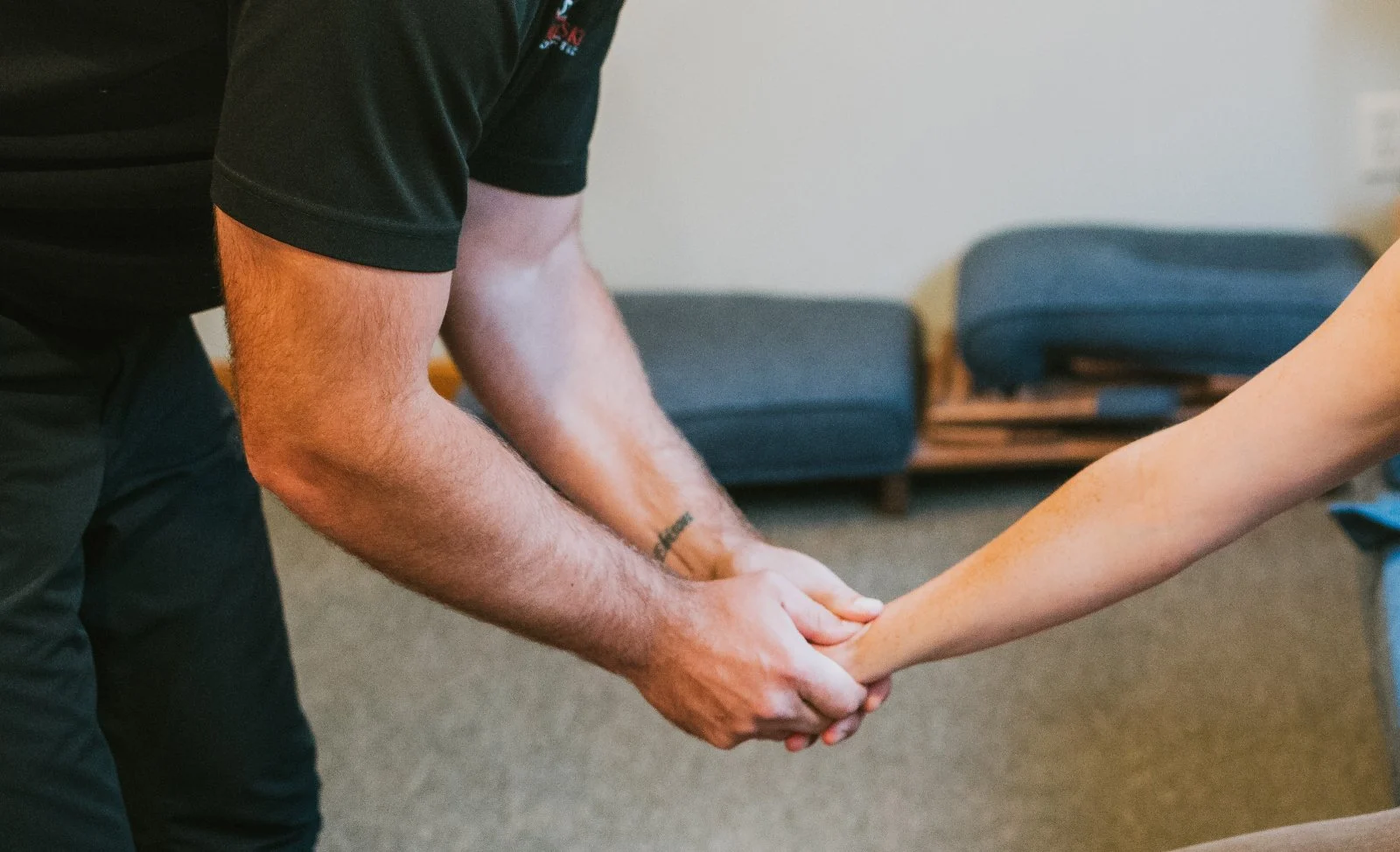
Common chiropractic wrist adjustment techniques include:
- Manual wrist adjustment: A precise, controlled movement to restore motion in the carpal bones. The goal is to improve glide between the scaphoid, lunate, and capitate rather than to force a pop. Most practitioners find that a low-amplitude movement works better than a high-velocity thrust when the nerve is already irritated.
- Flexion and extension mobilization: Gentle, repeated stretching of the radiocarpal and midcarpal joints to reduce stiffness without compressing the tunnel. This is often the first technique used when tingling is constant, because it lets the practitioner gauge nerve tolerance before any thrust is applied.
- Soft tissue release: Work on the forearm flexors, the flexor carpi radialis, flexor carpi ulnaris, and palmaris longus, that cross the wrist and can pull the transverse carpal ligament taut. Release here can open the tunnel indirectly without touching the wrist joint itself.
- Traction: A light pull to open space in the joint. Traction is typically applied along the long axis of the forearm and held for 10 to 30 seconds at a time, and it is often paired with gentle wrist motion to keep the joint from stiffening.
- Nerve gliding: Controlled sliding movements of the median nerve through the arm and wrist. This is not an adjustment, but it is commonly added to a wrist-focused plan because it addresses the nerve’s ability to move without friction.
- Cold Laser Therapy: Using light to excite cells on an intercellular level-increasing metabolic process, increasing blood flow, decreasing inflammation, and increasing the rate of healing.
Wrist manipulation is not appropriate for every patient. If you have severe numbness, muscle wasting at the base of the thumb, or symptoms that worsen sharply after a session, the plan needs to be reassessed rather than pushed harder.
If you want to see how these techniques fit into a full plan, our carpal tunnel care in Grand Rapids page walks through the exam, the adjustment sequence, and the home program we build around it.
What to Expect at Your First Visit
Your first visit is mostly about listening and measuring. We ask about your symptoms, your work setup, and what you have already tried. Then we examine the neck, shoulder, and wrist together.
The Gonstead five-component analysis includes:
- Visual inspection of posture and alignment
- Instrumentation to detect heat changes near the spine
- Static and motion palpation by hand
- Full-spine X-rays when needed
- Thermal scanning to confirm nerve irritation (Source: research on manual therapy for carpal tunnel syndrome)
This process helps us find the root cause instead of treating only the spot that hurts. You can see what to expect on your first visit, including a short video, so you arrive prepared.
Ergonomic Tips for Carpal Tunnel Prevention at Your Desk
Ergonomic tips for carpal tunnel prevention focus on keeping your wrist straight and your shoulders relaxed. Small changes at your desk add up over a workday.
Try these adjustments:
- Keep your wrists flat, not bent up or down
- Set your keyboard so your elbows sit near 90 degrees
- Use a wrist rest only for pauses, not while typing
- Keep your mouse close to the keyboard
- Take a short break every 30 minutes to stretch
- Raise your screen to eye level to ease neck strain
Workplace changes and regular breaks can help reduce strain on the wrist. An ergonomic assessment of your setup is worth the effort.
How to Reduce Wrist Inflammation Naturally
How to reduce wrist inflammation naturally starts with rest, ice, and gentle movement. These steps support recovery between visits and are simple to do at home.
- Ice the wrist for 10 to 15 minutes after activity
- Wear a night splint if your fingers go numb at night
- Do gentle wrist and finger stretches daily
- Stay hydrated and walk regularly
- Avoid gripping tools or lifting heavy items during flare-ups
At Kaminski Chiropractic, we give each patient at-home instructions to follow between adjustments. Following them is a big part of how well care works.
Recovery After an Adjustment and When to Expect Results
Most people feel some relief within a few visits, but full recovery takes time. Results depend on how long symptoms have lasted and how much nerve irritation is present. A common pattern is that tingling and night numbness ease before grip strength returns, because nerve irritation settles faster than the muscles that have been compensating.
A typical recovery timeline looks like this:
|
Phase |
What to Expect |
Typical Timeframe |
|---|---|---|
|
First visits |
Less tightness, easier motion |
1-2 weeks |
|
Early progress |
Reduced tingling, better sleep |
2-4 weeks |
|
Functional gains |
Stronger grip, fewer flare-ups |
4-8 weeks |
|
Maintenance |
Home exercises, ergonomic habits |
Ongoing |
What to Do If You Feel Worse After an Adjustment
This is the question most patients are afraid to ask, and most articles skip it. It is normal to feel sore for 24 to 48 hours after a session, similar to the soreness after a new exercise. It is not normal to feel sharp new pain, spreading numbness, or weakness that was not there before.
If you feel worse after an adjustment, do this:
- Ice, do not heat, for the first 24 hours. Apply ice to the wrist or forearm for 10 to 15 minutes at a time. Heat can increase swelling in an already irritated tunnel.
- Keep moving gently. Light wrist and finger range-of-motion keeps the nerve gliding. Resting completely for days tends to make stiffness worse.
- Sleep with the wrist neutral. A night splint holds the wrist at zero degrees, which is the position that puts the least pressure on the median nerve.
- Call the clinic the same day if symptoms are new or spreading. A flare that travels up the forearm or into the shoulder is a signal to reassess the plan, not to wait a week.
Watch out: Numbness that becomes constant, thumb weakness that makes it hard to pinch, or pain that wakes you from sleep are reasons to stop and get re-examined rather than to push through another adjustment.
When to Expect Results
Care should move you toward independence, not dependence. We track progress closely and adjust the plan as you improve.
A practical way to judge progress is to track three things at home: how many nights per week your fingers go numb, how long you can type before symptoms start, and whether you can open a jar without weakness. Those three markers tell us more than a pain score alone.
If you are in Grand Rapids and want a plan that includes a clear post-adjustment protocol, our carpal tunnel care in Grand Rapids page explains what we send home with every patient.
Requesting a Consultation at Kaminski Chiropractic
If wrist pain, numbness, or weakness is limiting your day, a proper exam is the best next step. At Kaminski Chiropractic, we offer a no-cost consultation so you can ask questions before committing to care. We use the Gonstead technique, tailor every plan to the patient, and offer flexible scheduling for Grand Rapids residents.
You can book a chiropractic appointment in Grand Rapids online in a few minutes.
Numbness and tingling in your hand do not have to be something you learn to live with. Kaminski Chiropractic brings over a decade of experience, precise Gonstead analysis with full-spine X-rays and thermal scanning, and care built around your specific case. Get started with Kaminski Chiropractic and take the first step toward moving freely again.
Frequently Asked Questions
How does a chiropractor treat carpal tunnel syndrome?
A chiropractor examines the full nerve path from the neck through the shoulder, elbow, and wrist. Treatment may include spinal adjustments, wrist and forearm joint mobilization, and soft tissue work to reduce pressure on the median nerve. At Kaminski Chiropractic, the Gonstead system uses full-spine X-rays and thermal scanning to help locate the source of the problem.
How long does it take to see results from carpal tunnel chiropractic care?
Some patients notice less numbness or tingling within a few visits, while others need several weeks of care. Results depend on how long symptoms have been present, whether nerve damage has occurred, and how consistently you follow at-home instructions. Your treatment plan should be reviewed regularly, and you should ask for clear milestones so you know whether care is working.
Can neck or shoulder misalignment contribute to carpal tunnel symptoms?
Yes. The median nerve travels from the lower neck through the shoulder, elbow, and wrist. A misalignment or muscle tension anywhere along that path can add pressure and worsen numbness or tingling in the hand. That is why a chiropractor evaluates the whole arm and spine rather than only the wrist.
Is chiropractic care safe for carpal tunnel during pregnancy?
Many pregnant patients develop carpal tunnel symptoms from fluid retention and postural changes. Chiropractors modify positioning and use gentle techniques for expectant mothers. Tell your provider you are pregnant before any adjustment so the treatment plan can be adapted. Ask about the clinic’s experience with prenatal care and whether your obstetric provider should be consulted first.
