
Quick Summary
Family wellness with chiropractic care means assessing each household member separately and matching care to their age and needs. Kaminski Chiropractic starts with a thorough evaluation for each person before recommending any care. Children, adults, and older adults each need a different approach.
- Each family member receives a thorough individual evaluation before any care is recommended
- Gentle, low-force techniques are commonly used for infants and young children
- Pregnant patients should clear chiropractic care with their obstetric provider first
- Chiropractic adjustments can cause soreness or stiffness for a day or two afterward
- Bring a short written note for each person describing the main concern and history
Table of Contents
- What Does Chiropractic Wellness for Families Look Like?
- How Spinal Health Shapes Wellness at Every Age
- Chiropractic Care for Children: Growth, Development, and Safety
- Chiropractic Adjustment Risks and How Gonstead Evaluation Addresses Them
- Prenatal, Adult, and Older Adult Considerations
- Planning Your First Family Visit in Grand Rapids, MI
- Booking a Family Evaluation at Kaminski Chiropractic
- Frequently Asked Questions
How to Support Family Wellness With Chiropractic Care (Source: National Center for Complementary and Integrative Health overview of spinal manipulation)
Last Updated: November 23, 2026
What Does Chiropractic Wellness for Families Look Like?
Family wellness with chiropractic care means every member of the household gets assessed and cared for at the level that fits their age and needs. A toddler, a teenager, a working parent, and a grandparent do not all need the same thing. At Kaminski Chiropractic, Dr. Paul Kaminski starts with a thorough evaluation for each person before recommending any care.
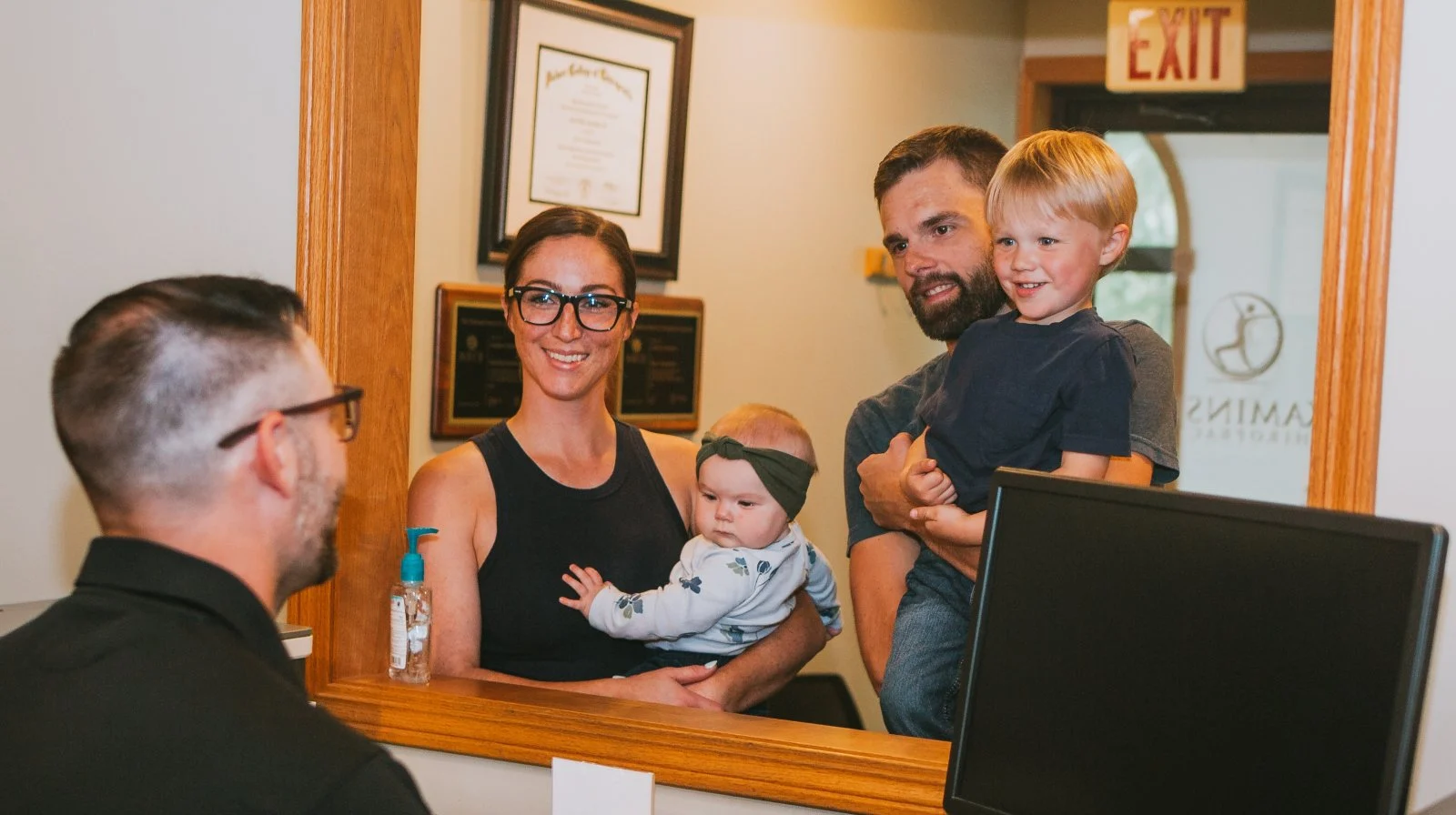
Chiropractic is a conservative, hands-on approach that focuses on the spine, joints, and nervous system. It is one option among several for common complaints like back pain, neck pain, and headaches.
Chiropractic wellness care for families can include an individual evaluation for each family member, age-appropriate care, advice on movement and posture, and referral to other providers when a symptom needs medical attention.
How Spinal Health Shapes Wellness at Every Age
The spine protects the spinal cord, which carries signals between the brain and the rest of the body. It also supports posture and allows movement. When a joint in the spine does not move normally, muscles around it can tighten, and nearby nerves can become irritated. Over time, this can affect how a person sits, walks, sleeps, and exercises.
The spine changes across life. Infants are building their posture from scratch, children grow quickly, adults sit for long hours, and older adults often deal with disc wear and joint stiffness. Each stage brings different strains, so a single approach rarely fits everyone.
Research on chiropractic for neck and back pain is broad, and quality varies. A National Center for Complementary and Integrative Health overview of spinal manipulation describes what the evidence shows for different conditions, and it is worth reading before making decisions. Evidence is strongest for certain adult back and neck complaints and weaker for many other uses.
Chiropractic Care for Children: Growth, Development, and Safety
Parents often ask whether chiropractic is safe for children. Gentle, low-force techniques are commonly used for infants and young kids, and they differ greatly from the forceful adjustments some people picture. The right technique depends on the child’s age, size, and reason for the visit.
Common concerns in children include posture changes from carrying heavy backpacks, pain after sports or falls, and headaches or fussiness that the family wants checked. A careful evaluation should rule out problems that need medical care first.
Consider these safety steps when your child is evaluated:
- Ask the provider how they adjust children of your child’s age
- Ask what they check before recommending any adjustment
- Confirm when the child should be referred to a pediatrician
- Ask about the warning signs that mean you should seek care right away
For a deeper look at this topic, see Pediatric Chiropractic in Grand Rapids, MI and our guide on whether pediatric care is safe for kids.

Chiropractic Adjustment Risks and How Gonstead Evaluation Addresses Them
Chiropractic adjustments are not risk-free. Some people feel soreness, stiffness, or tiredness for a day or two after an adjustment. Rare but serious complications have been reported, most often involving the neck. That is one reason a careful evaluation matters before any adjustment.
The Gonstead approach emphasizes thorough analysis before adjusting. It looks at posture, spinal movement, and the neurological and orthopedic signs that help show which joints need care and which do not. Evaluation may include thermal scanning and full-spine X-rays when clinically indicated.
Prenatal, Adult, and Older Adult Considerations
A family practice sees the same spine at very different stages of life, and the clinical reasoning changes with each one. Pregnancy, the desk-bound adult years, and older adulthood each load the spine differently, and each carries its own safety considerations and referral triggers. Treating all three the same way is where care goes wrong.
Pregnancy and the postpartum period. As pregnancy progresses, the center of gravity shifts forward, the lumbar curve typically deepens, and the hormone relaxin increases ligamentous laxity in the pelvis. That combination changes how the sacroiliac joints and lower back carry load, which is why many expectant mothers describe a deep ache across the belt line or pain that flares when rolling over in bed or climbing stairs. Watch out: sharp abdominal pain, vaginal bleeding, fluid leakage, severe headache with visual changes, or reduced fetal movement are obstetric emergencies, call your provider or 911, not a chiropractor. (Source: American Academy of Pediatrics policy statement)
Working-age adults. Most adults who walk into a family practice are not there because of one dramatic injury. They are there because a pattern has accumulated: eight hours at a desk in Grand Rapids traffic, a phone held at chest height, a weekend of yard work in Cascade, or a gym routine that outpaces recovery. The clinical picture often mixes postural strain, joint stiffness at one or two segments, and muscular guarding.
Older adults. Arthritis, disc desiccation, and reduced bone density change both what is safe and what is realistic. Gentle, low-force techniques and careful positioning matter more here, and a provider should ask about osteoporosis, long-term steroid use, recent falls, and anticoagulant medications before any manual treatment. A common pattern is stiffness and reduced rotation in the mid-back and neck that limits looking over the shoulder while driving. Improvement is often measured in function, getting out of a chair, reaching overhead, walking the neighborhood, rather than in pain scores alone.
For expectant mothers, our pregnancy chiropractic page is a useful starting point. For older adults and adults with long-standing complaints, the Gonstead approach page describes how a full evaluation guides whether care is appropriate.
The article’s guidance differs by life stage, so the key points for each group are summarised below.
|
Life stage |
Main consideration |
Watch out for |
|---|---|---|
|
Pregnancy and postpartum |
Relaxin and shifting centre of gravity change load on the pelvis and lower back |
Abdominal pain, bleeding, fluid leakage, severe headache with visual changes |
|
Working-age adults |
Postural strain and accumulated joint stiffness, often with muscular guarding |
Progressive leg weakness, saddle numbness, unexplained weight loss, night pain |
|
Older adults |
Arthritis, disc wear and reduced bone density limit safe techniques |
New back pain after a fall, new numbness or weakness, bladder or bowel changes |
Planning Your First Family Visit in Grand Rapids, MI
Most of what families search for before a first chiropractic visit is not clinical, it is logistical and emotional. Will this hurt? How long will it take? What do I bring for a toddler versus a teenager versus my mother? The top-ranking articles describe benefits but rarely walk a family through the actual appointment. Here is what a first family visit looks like in practice, and how to decide whether to come back.
Before you book. Call the office and ask three questions: whether siblings can be scheduled back-to-back, how long a first evaluation typically runs (it is usually longer than a routine visit because it includes history, examination, and a discussion of findings), and what the practice’s policy is on insurance and payment. Kaminski Chiropractic operates outside traditional insurance networks, so ask about fees and payment options when you book, and check with your own insurer about any out-of-network benefits before your appointment. Families driving in from Cascade, Forest Hills, or Ada should confirm office hours and parking so the first visit does not start with stress.
What to bring for each family member. A short written note for each person is more useful than a long verbal history in the room. Include the main concern, when it started, what makes it better or worse, and any prior imaging or records. Bring a current medication list, including supplements and anything prescribed during pregnancy, and, for children, any relevant pediatrician notes. For infants and young children, bring a diaper bag, a favorite comfort item, and a snack; a calm child is easier to examine.
What the evaluation covers. Expect a health history, a physical examination, and a discussion of what was found and what the options are. Evaluation at Kaminski Chiropractic may include thermal scanning, static and motion palpation, neurological and orthopedic testing, and full-spine X-rays when clinically indicated. The goal of the first visit is to determine whether chiropractic care is appropriate for each person and, if it is not, to say so and suggest other options.
Questions worth asking on the first visit. Ask how the provider decided what to examine, what the working diagnosis is, what the proposed plan involves, how progress will be measured, and what would prompt a referral to another clinician. Ask specifically how care is adapted for your child’s age or for a pregnant family member. A provider who welcomes these questions is a good sign; one who deflects them is not.
How to decide on next steps. A reasonable plan has a clear goal, a way to measure progress, and a point at which the approach is reconsidered if things are not improving. Watch out: be cautious of any practice that recommends long-term or indefinite visit schedules before an evaluation, that discourages you from asking about alternatives, or that suggests chiropractic care can replace medical treatment for a diagnosed condition. Those are reasons to pause, not to commit.
If you are ready to schedule, request a family evaluation and bring your questions. Our Chiropractic FAQs in Grand Rapids, MI cover hours, payment, and what to expect at a first visit.
Booking a Family Evaluation at Kaminski Chiropractic
If you are considering chiropractic care for your family, the first step is an evaluation. Dr. Kaminski will talk with you about your concerns, examine each person, and explain what he finds and whether chiropractic care fits. If it does not, he will tell you and suggest other options.
Call the office or request an appointment to start, and bring your questions. Visit Chiropractic FAQs in Grand Rapids, MI for answers to common questions about hours, payment, and what to expect at a first visit.
Frequently Asked Questions
Can a chiropractor treat multiple members of the same family?
Yes. Many chiropractic offices see parents, children, and grandparents, and each person gets their own evaluation and individualized plan. At Kaminski Chiropractic, every family member is assessed separately, because a child’s spinal development, an adult’s work-related strain, and an expectant mother’s changing posture call for different findings and different care. Shared visits can make scheduling easier, but the clinical reasoning should stay individual for each patient, and any recommendations should reflect that person’s needs and progress.
Is chiropractic care appropriate for children?
Chiropractic care is commonly provided to children, but it should be gentle and matched to the child’s age and size. Evaluation starts with a careful history and examination, and adjustments for infants and young children use very light, specific pressure. Parents should share any birth history, injuries, or symptoms such as persistent headaches, unusual posture, or neurological changes. A child with warning signs should be evaluated by a physician promptly, and a qualified chiropractor will refer out when medical care is needed.
What are the possible risks or side effects of chiropractic adjustments?
Most people experience mild, short-lived soreness or stiffness after an adjustment, and this usually settles within a day or two. Less common effects can include headache or fatigue. Serious complications are rare but have been reported, particularly with neck adjustments. A careful evaluation, including a review of medical history and warning signs, helps identify who may need a different approach or medical referral before care begins. If you notice a severe or unusual headache after an adjustment, contact your provider and seek medical evaluation right away.
How does a Gonstead chiropractor evaluate spinal function?
The Gonstead approach emphasizes a thorough, multi-step analysis rather than a single test. At Kaminski Chiropractic, evaluation may include a detailed history, static and motion palpation, neurological and orthopedic assessment, thermal scanning, and full-spine X-rays when clinically indicated. Findings are interpreted together to identify specific areas of spinal dysfunction and how they may relate to your symptoms. This allows adjustments to be individualized rather than generalized, and it gives you a clear explanation of what was found.
